
Wheel fitment is the process of determining whether a wheel is compatible with your vehicle. Proper fitment depends on several measurements, including bolt pattern, wheel diameter, wheel width, backspacing, center bore, break clearance, and tire compatibility. Verifying these specifications helps ensure safe operation and proper vehicle performance.
Will These Wheels Fit? The Complete Wheel Fitment Guide

Wheel Fitment Checklist
Before buying new wheels, verify:
- Bolt pattern
- Wheel diameter
- Wheel width
- Offset
- Backspacing
- Center bore
- Brake clearance
- Tire compatibility
WHAT IS WHEEL FITMENT?
Wheel fitment, sometimes called tire fitment or just fitment, is the process of matching tires and wheels to your vehicle’s exact specification. This is necessary to ensure safety, proper handling, and performance.
It combines many measurements together to create one clear picture of how a set of tires and wheels will pair with your vehicle. These measurements include not only your wheel and tire’s sizes, but also aspects of your vehicle’s design, such as brake clearance.
| At-A-Glance Fitment Terminology Guide | |
|---|---|
| Term | Definition & Why It Matters |
| Wheel size | Includes diameter, width, bolt pattern, and offset. Must be compatible with your vehicle’s specifications. |
| Fitment | How a wheel and tire physically mount and align with your vehicle’s wheel well. Proper fitment prevents rubbing and other driving issues. |
| Bolt pattern | A two-part number including the number of bolt holes and the measurement of the imaginary circle formed by the lugholes at your wheel’s center. Also called a lug pattern. Your wheel bolt pattern must match your vehicle’s wheel hub to mount safely. |
| Wheel diameter | The distance across the face of the wheel, measured in inches. Your wheel, tire, and wheel well clearance must be compatible to safely install. |
| Wheel width | Distance across the barrel of the wheel, measured in inches. Directly affects how your ride handles and the tires you can choose. |
| Offset | The distance from the mounting surface of the wheel to the wheel’s centerline, in millimeters. Prevents rubbing on brakes, fenders, and suspension components and changes the vehicle’s stance. |
| Backspacing | The distance from the mounting surface to the back of the wheel, measured in inches. It directly correlates to your offset. Prevents rubbing on brakes, fenders, and suspension components and changes the vehicle’s stance. |
| Center bore | The hole in the center of the wheel that directly attaches to the vehicle’s wheel hub. Wheels are either hub-centric (OEM) or lug-centric (aftermarket) but can be made hub-centric with a hub ring. Your chosen wheel must be compatible with the center bore and lug hardware to fit safely. |
| Lug hardware | The hardware used to secure your wheel and tire assembly to your vehicle. The correct lug nut ensures your wheel is safely and securely installed. |
| Brake clearance | The space between a vehicle’s wheels (including the barrel and spokes) and the brake components (calipers, rotors, etc.). Proper clearance allows the wheel to spin freely without scraping or rubbing against components. |
| TPMS compatibility | Tire Pressure Monitoring Systems (TPMS) are not universal and must be tuned/compatible with your vehicle’s computer. TPMS sensors must match frequency, sensor type, and wheel clearance to function with your vehicle. |
MEASUREMENTS THAT DETERMINE WHEEL FITMENT
There are a number of measurements that determine wheel fitment. These include:
- Bolt pattern
- Wheel diameter
- Wheel width
- Offset
- Backspacing
- Center bore
For tire sizing help, check out our page on how to read your tire size.
America's you wheels and tires that fit both your vehicle and your needs. Just ask!
FIND YOUR STORE
Understanding Wheel Offset
Wheel offset is the distance from the mounting surface to the centerline of the wheel. It is measured in millimeters. It is often stamped onto the back of the center of your wheel.
Offset affects how your wheels both fit and look.
| Wheel Offset Position Guide | ||
|---|---|---|
| Positive | Zero | Negative |
| More wheel toward your vehicle | Centered | Pushed past the center of the wheel, wide stance |
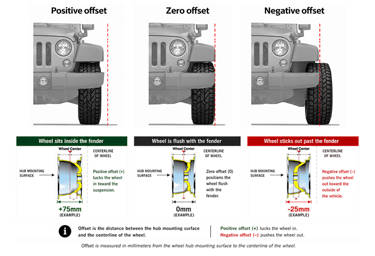
Many rear-wheel drive and off-road vehicles have zero or negative offset wheels (often deep dish wheels) to take advantage of improved stability and increased aggressive appearance.
Your stance should reflect how you use your vehicle as an incorrect one will directly affect your ride’s performance.
Offset vs Backspacing: What’s the Difference?
Offset and backspacing are two different ways to measure how your wheels fit on your vehicle. They describe how far in or out your tires and wheels are positioned.
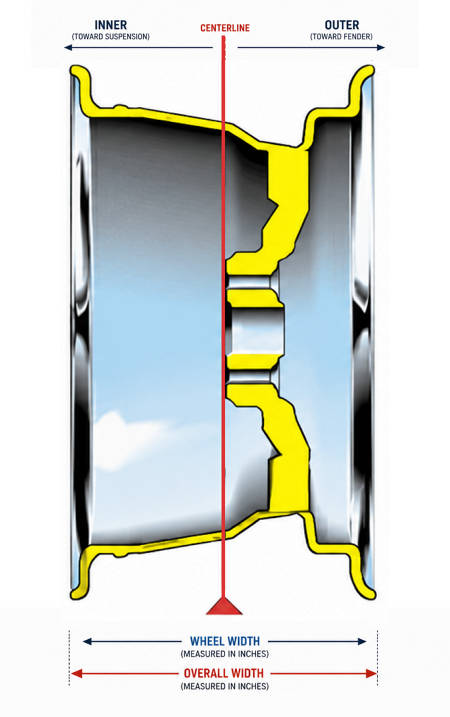
Backspacing is an older measurement that measures how far the wheel’s back lip sits in relation to the mounting surface. It is measured in inches. Higher measurements indicate a closer seat while lower measurements indicate a further away position.
Expert Input

Offset and backspacing are often confused with each other but they affect different aspects of wheel assembly position. Here’s a quick comparison:
| Offset vs Backspacing Comparison | ||
|---|---|---|
| Offset | Backspacing | |
| What it does… | The distance from the centerline of the wheel to the hub mounting surface | The distance from the back inside edge of the wheel to the hub mounting surface |
| How it’s measured… | Millimeters | Inches |
| What it affects… | Stance; how the tires sit in relation to the vehicle’s wheel well | How much space is available behind the wheel to clear brakes and suspension components |
| Can it change?* | Yes, when wheel width does | Yes |
*Offset will change when the wheel width does. However, backspacing will change if you change the tire’s width (even if the offset is identical).
How Wheel Width Affects Fitment
Wheel width is the distance between the wheel’s bead seats (surfaces where the tire mounts). It’s important to choose the correct wheel width so your tire can be safely mounted, ensuring proper clearance for your vehicle’s suspension, brakes, and fenders.
Wheel width affects fitment due to:
- Safe tire installation
- Tire and wheel compatibility
- Component clearance
Every tire is designed to fit within an approved range of wheel widths. Mounting a tire that falls outside of that range can:
- Affect handling
- Cause irregular tire wear
Always verify that both wheel and tire are compatible with each other and your vehicle.
Need help? We’re here to get you taken care of!
SCHEDULE A FREE CONSULT
Choosing the Right Wheel Diameter
Wheel diameter is the measurement across the face of your wheel from one side to the other (bead to bead). It’s measured in inches. When you measure, subtract 1 ¼ inches to get the true measure. Tires and wheels must have the same diameter. For example, a 17-inch tire must be installed on a 17-inch wheel.
You should consider more than just appearance when selecting a new wheel. The wheel and tire combination must provide proper clearance and maintain compatibility with your manufacturer’s specifications.
America's Tire recommends choosing wheel diameters that are appropriate for your specific vehicle.
Understanding Wheel plus Sizing
Many drivers choose to increase wheel diameter through plus sizing, which pairs a larger wheel with a lower-profile tire to keep the overall tire diameter close to the original equipment (OE) size.
Maintaining a similar overall diameter helps preserve speedometer accuracy, vehicle gearing, and overall fitment.
DO BIGGER WHEELS AFFECT FUEL ECONOMY?
All wheels can affect fuel economy to some degree. Factors include:
- Weight
- Aerodynamics (wheel design)
- Width
- Diameter
Essentially, heavier and wider/bigger wheels increase rotational mass, which forces your engine to work harder (and burn more fuel).
Some wheel designs, such as open spoke, impact the way air flows along the sides of your vehicle, increasing drag. You may notice that electric vehicles (EVs) tend to have solid or aero-capped wheels that channel air smoothly and minimize resistance.
HOW TO KNOW IF WHEELS WILL FIT YOUR VEHICLE
If you’re shopping for new wheels on your own, you will need to verify the following to make sure they fit your vehicle:
- Bolt pattern
- Wheel diameter
- Wheel width
- Offset and backspacing
- Center bore
- Load rating (especially for large vehicles)
- Brake clearance
- Tire compatibility
- Suspension and fender clearance
The easiest way to ensure your wheels will fit is to ask us! We’re your tire and wheel experts!
FIND MY STORE
You can preview your chosen rims with our wheel visualizer!
WHEEL VISUALIZERCOMMON WHEEL FITMENT MISTAKES
Here are the most common wheel fitment mistakes buyers make:
- Ignoring specifications
Many buyers only focus on wheel width and diameter. You need to pay attention to all specifications, including load rating, bolt pattern, and center bore. - Failing to verify clearance
Includes brake clearance, suspension, and “full lock” steering wheel clearance (when you turn your wheel all the way and the tire rubs your fenders). - Using incorrect hardware or specs
This can include using incorrect lug seats, mixing up your offset, or not using a compatible TPMS.
FAQ
Wheel fitment, sometimes called tire fitment or just fitment, is the process of matching tires and wheels to your vehicle’s exact specification. This is necessary to ensure safety, proper handling, and performance.
The easiest way to see if wheels will fit your vehicle is ask us at America's Tire. If you’re shopping on your own, match the following specifications: bolt pattern, wheel diameter, wheel width, offset and backspacing, center bore, load rating, brake clearance, tire compatibility, and suspension and fender clearance.
No. Aftermarket wheels are not universally sized. You will need to select one that matches your vehicle and tire’s specifications.
That depends on your vehicle’s make, model, and year plus the look and performance you want. Need help? Give us a ring.
Offset and backspacing are both different ways to measure how your wheel fits on your vehicle. Offset is measured in millimeters and refers to the distance from the centerline of the wheel to the hub mounting surface. Backspacing is measured in inches and refers to the distance from the back inside edge of the wheel to the hub mounting surface.
Offset is more about a vehicle’s stance; backspacing is more about the degree of available clearance for important components.
Yes, wheel width affects safety, tire compatibility, and component clearance.
Yes, but you must ensure compatibility with several factors, including bolt pattern, offset/backspacing, clearance, load capacity, tire compatibility, and other sizing factors. You may need to install a lift or level kit to fit the new wheels.
Yes, to some degree. Larger, heavier wheels require more energy to roll which results in more fuel consumed.
Plus sizing is when you pair a larger wheel with a lower profile tire to maintain the original equipment size diameter.
Ready to roll?
If you have any questions or are unsure what tires work best for you, drop in or give us a ring. We’ll get you taken care of. Buy and book online and save time in-store!
For more information on this and other tire and wheel services, check out ourYouTube Channel or reach out to us on X, Instagram and Facebook.