
WHAT ARE FLOTATION TIRES?
The Tire and Rim Association defines high flotation tires as, “A tire which is dimensionally larger and operates at a lower inflation pressure than the tire it replaces [the original metric tire] to provide improved flotation in off-the-road service.”
Flotation tires can travel over soft terrain. Flotation tires are typically large, extra-wide, and large volume tires with wider footprints for a bigger contact patch to “float” over soft surfaces. For this reason, they are commonly used in off-road and agricultural driving conditions.
“Flotation” is the name of the sizing system which is measured in inches. They’re called this because the larger air volume requires lower pressure to carry the same weight as a thinner tire.
“High flotation tires are 12-inches (305mm) and wider, with the majority being over 30-inches in diameter,” says Gary Ruede, Discount Tire’s Principal Product & Quality Management Technologist.
Common vehicles that use high flotation tires include:
- Large trucks
- Farming equipment
- Off-road vehicles including Jeeps
- ATV/UTVs
- Golf carts or other specialty vehicles
HOW DO FLOTATION TIRES WORK?
Flotation tires work by spreading your vehicle’s weight over a wider surface area compared to typical tires. A larger footprint allows your tire’s psi to be lower, “floating” your vehicle across soft surfaces instead of sinking or getting stuck.
How the design works:
- Wide footprint
The extra wide, large volume design distributes heavy loads evenly instead of concentrated small points. - Low air pressure
Flotation tires can safely run at lower psi levels, allowing sidewalls to flex and expand the contact patch against the ground. - Surface riding
Instead of digging down into soft dirt, the tire stays on top of the terrain (like snowshoes in deep snow).
HOW TO READ A FLOTATION TIRE SIZE
Flotation tire sizes are read similarly to metric tire sizes; they just swap section width and aspect ratio for tire diameter and width measured in inches.
Below is a sample flotation tire size:
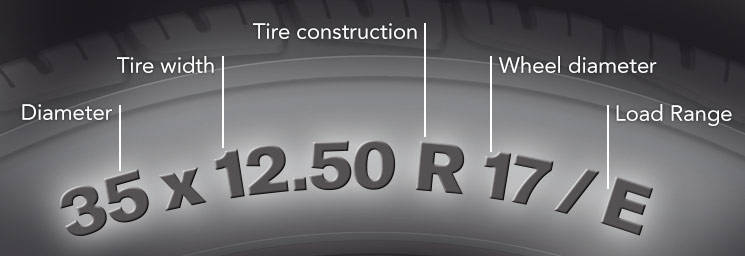
The components in our example include:
- Diameter (tire height): 35 inches tall
- Tire width: 12.50 inches wide
- Tire construction: Radial construction
- Wheel diameter: 17 inches tall
- Load range: E
You may also find the load index at the end of the size sequence, possibly separated by a slash or space. Typically, you will see the load range listed but you can find the load index on your driver-side door jamb sticker or the owner’s manual instead.
Most Popular Flotation Sizes for Pickups, SUVs, & Jeeps
FLOTATION TIRES VS METRIC TIRES
The main difference between flotation and metric tires is how they are measured. Flotation tires are measured in inches while metric tires are measured in millimeters and ratios.
“Flotation tires have a larger manufacturing tolerance than metric tires, and can be wider and taller by more than 3-5%,” says Gary Ruede.
Flotation tires:
- Are measured in inches
- Have a wide footprint
- “Float” over the top of soft surfaces
- Come in radial and bias-ply construction
- Allow for lower air pressure
- Are ideal for off-road, lifted, and agricultural vehicles
Metric tires:
- Are standard on most factory vehicles
- Are measured in millimeters and ratios
- Come in a huge range of load ranges
- Offer a better on-road drive
FLOTATION TIRE SIZE CONVERSION CHART
Flotation tires have a direct metric equivalent. Here are some common examples:
| High Flotation Tire Conversion | ||
|---|---|---|
| High-Flotation Sizes | Metric Sizes | |
| 15" Tire Sizes | 29x9.50R15 | 235/75R15 |
| 30x10R15 | 255/75R15 | |
| 31x10.5R15 | 265/75R15 | |
| 32x11R15 | 285/75R15 | |
| 16" Tire Sizes | 30x9.5R16 | 245/75R16 |
| 31x10.5R16 | 265/70R16 | |
| 32x10.5R16 | 265/75R16 | |
| 33x11R16 | 285/75R16 | |
| 33x12R16 | 305/70R16 | |
| 35x12.5R16 | 315/75R16 | |
| 17" Tire Sizes | 32x10.5R17 | 265/70R17 |
| 32x11R17 | 275/70R17 | |
| 33x11R17 | 285/70R17 | |
| 33x11.5R17 | 295/70R17 | |
| 34x12R17 | 305/70R17 | |
| 34x12.5R17 | 315/70R17 | |
| 35x12.5R17 | 315/70R17 | |
| 37x12.5R17 | 315/80R17 | |
| 18" Tire Sizes | 33x11R18 | 275/70R18 |
| 33x11R18 | 285/65R18 | |
| 35x11R18 | 285/75R18 | |
| 34x11.5R18 | 295/70R18 | |
| 34x12R18 | 305/65R18 | |
| 35x13R18 | 325/65R18 | |
| 20" Tire Sizes | 32x11R20 | 275/55R20 |
| 33x11R20 | 275/60R20 | |
| 33x11R20 | 285/60R20 | |
| 34x11.5R20 | 295/60R20 | |
| 33x12R20 | 305/55R20 | |
| 35x11.5R20 | 295/65R20 | |
| 35x12.5R20 | 325/60R20 | |
| 35x13R20 | 325/60R20 | |
| 22" Tire Sizes | 32x11R22 | 285/45R22 |
| 35x13R22 | 325/50R22 | |
| 24" Tire Sizes | 32x12R24 | 305/35R24 |
| 35x11R24 | 275/50R24 | |
| 34x11.5R24 | 295/45R24 | |
| 35x12.5R24 | 315/45R24 | |
| 36x12.5R24 | 315/50R24 | |
| 35x14R24 | 355/40R24 | |
| 36x15R24 | 375/40R24 | |
| 38x13.5R24 | 345/50R24 | |
WHAT ARE FLOTATION TIRES USED FOR?
Flotation tires are commonly used for vehicles that need to handle soft off-road surfaces, such as loose soil, sand, or mud. Common vehicles that utilize flotation tires include:
- Jeeps
- Lifted trucks/SUVs
- Agricultural equipment
- Gardening/lawn equipment
- ATV/UTVs
- Golf carts
Understandably, we sell the most flotation tires in Texas!
BENEFITS AND DRAWBACKS OF FLOTATION TIRES
Like any tire category, flotation tires have benefits and drawbacks.
| Pros & Cons of Flotation Tires | |
|---|---|
| Pros | Cons |
| Lower soil compaction* | Higher cost |
| Improved soft-terrain performance | Poor on-road handling |
| Cushioned ride | Increased noise and wear |
| Boosted off-road stability | Lower traction on pacted surfaces |
*protects sensitive crops and wet fields
WHAT TO CONSIDER BEFORE SWITCHING TO FLOTATION TIRES
There are a number of factors to consider before switching over to flotation tires. These include:
- Fenderwell and suspension clearances
Wider tires require more room to turn without rubbing. - Tire height and width
- Rim width
- Offset and backspacing
- Load carrying capacity
Ensure your tire’s load index safely matches your maximum gross vehicle weight (MGVW). - Air pressure
You must manage your air pressure carefully because lower psi will help in soft off-road surfaces but paved roads and highway speeds require higher air pressure.
In addition, switching to flotation tires from metric tires will alter your vehicle’s:
- Gearing and speedometer accuracy
Larger diameter tires can change your final drive ratio and speedometer accuracy - Fuel economy
Larger, heavier tires can reduce fuel economy due to increased rolling resistance. - Noise level
Large tread blocks with wide contact patches create more noise and can create a rougher ride on pavement. - Wet weather traction
Extra-wide tread elements can increase the risk of hydroplaning on paved surfaces.
FAQs
A flotation tire is a tire used for work on soft-soil and is typically a larger, wider construction. It is measured in inches and is commonly found on agricultural, lawncare, and off-road vehicles.
Flotation tires got their name from how they seem to “float” over soft surfaces like soil, sand, and mud.
Flotation tires sizes are read similarly to metric tires except they swap section width and aspect ratio for tire diameter and width measured in inches.
It means the tire is 35 inches in diameter, 12.50 inches wide, and on a 20’’ wheel with a radial construction.
Flotation tires are measured in inches, not millimeters like metric tires. They also list the tire’s diameter and width as opposed to aspect ratio and section width.
No, flotation tires are not the same as LT tires. LT (light-truck) tires are metric tires with a heavy-duty construction and load capacity. Flotation tires designate a sizing system measured in inches and typically have a large, wide design.
Yes, flotation tires are excellent for driving on sand as they allow your vehicle to avoid sinking into it.
Yes, flotation tires are excellent for driving on mud. They help prevent your vehicle from sinking into the muck.
Yes, if they are DOT-approved for highway use. However, large agricultural or industrial flotation tires are typically considered unsafe or illegal for paved high-speed use.
Yes, as long as your new flotation tires match your vehicle’s safety and fitment specifications, including load capacity, overall diameter, and width.
Yes, typically flotation tires require wheels that match their extra large width. If you mount flotation tires on a rim that is too narrow, it will pinch the sidewall, causing uneven treadwear, dangerous handling, and even bead unseating.
Yes, flotation tires can affect gas mileage. Larger tires can experience reduced efficiency as they have increased rolling resistance.
Yes, if your flotation tire’s overall diameter differs from your vehicle’s stock tires it will cause your speedometer to read slower than your actual speed. This is due to larger tires covering more ground in one rotation.
The correct air pressure for your flotation tires heavily depends on the recommended air pressure and load index for your original equipment tires and whether you are driving on paved or unpaved surfaces. Then, using a C2, D2, or E2 load range chart, find a load that is equal or greater than your OE load recommendation and use the associated recommended psi. You can always ask a tire expert at America's Tire for help!
Do you have more questions about high flotation tires? Give us a call or stop by your local store. Save yourself some time and book an appointment online first!
Schedule an AppointmentGet a shorter wait time in-store when you buy and book online!