
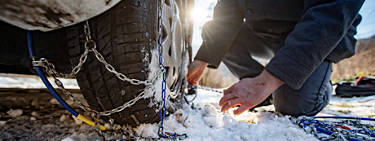
Tire chains (also called snow chains) offer an additional level of traction when roads are packed with deep snow and ice. They are not for every winter driving situation but do offer high levels of grip.
Many drivers choose not to use them because they require practice to install, require low driving speeds, and may not be legal in every state. However, they may be required in certain areas or conditions.
SHOP TIRE CHAINSYou can also check out our tire and snow chain buyer’s guide!
SNOW CHAINS QUICK ANSWERS
Here are some quick answers about snow chains:
Install tire chains on your drive wheels (front for FWD, rear for RWD, all four for AWD/4WD).
Max speed is 30mph or less (always follow manufacturer’s instructions).
Tire chains are for unplowed, compacted, or deep snow/ice conditions; Remove tire chains on clear paved surfaces.
Always match chains to your exact tire size and retighten/adjust after driving 100-200 feet post installation.
Tire chain requirements vary by state and highway conditions – check local DOT guidelines.
HOW TO PUT SNOW CHAINS ON TIRES
Snow chains help you confidently navigate extreme winter conditions. Check out our step-by-step process below or user-friendly video for installation.
What you’ll need:
Correctly sized chains
Tensioners/bungee cords (if required by chain type)
Owner’s manual
Gloves and/or kneeling mat or tarp
Headlamp/flashlight (low light conditions)
Remove chains from their package and untangle them.
Lay them on the ground next to their corresponding tires.
-
Fit them over the top of the tire; ensure that they are straight and hanging down.
Tuck the chains between the bottom of the tire and the ground to hold them in place when you drive forward.
Some chains use ring fasteners and fasten on the inside of the wheel, requiring you to work under your vehicle to install them.
Move your vehicle forward a little bit to expose the unfitted part of the tire.
Turn the wheel to the inside to give you better access to the unfastened portion of the chain.
Connect the chains together to cover the remainder of the tire. Ensure that the inner and outer connections are aligned.
Repeat for remaining tires.
Drive about 100 feet and retighten the chains to ensure they’re good to go.
Each chain type and brand may have a different process—always check with your owner’s manual! Also, chains frequently require bungee cords to help tighten them.
It’s important that your chains are fitted to your wheel size.
Snow chains are legal in all 50 states, but check on your state’s regulations for when they’re permitted. Typically, it’s from late October/early November to late March or early April.
Can you drive in the snow without chains?
Yes, you absolutely can drive in the snow without tire chains.
Tire chains are meant for extremely snowy and icy conditions where the roads have not yet been (or cannot be) paved. Mountain passes are frequently a place where tire chains are required, often for specific vehicles like semi-truck and trailers.
Tire chains may be overkill for most drivers. Practicing safe winter driving skills and using winter tires should get you where you need to go (safely) in most situations.
Want to learn more about tire chains? Check out our tire chains page!
Do you need to put snow chains on all four tires?
Where you place your tire chains depends on what kind of drive train your vehicle has. You should attach snow chains to the drive wheel tires.
Front-wheel drive (FWD) vehicles only need chains on the front two tires.
Rear-wheel drive (RWD) vehicles only need chains on the back two tires.
Four-wheel drive (4WD) and all-wheel drive (AWD) vehicles need chains on all four tires.
Check out our blog on what wheel drive is best in snow.
Tire chains are installed on the drive tires because they control the forward movement of your vehicle. Tire chains use the weight of your vehicle to dig into ice and snow and add additional traction.
Make sure to read the instructions that come with your tire chains for additional information.
How fast can you drive with snow chains?
Most snow chain manufacturers recommend a maximum speed of 30mph while tire chains are installed on your vehicle.
Tire chains are used in extreme weather conditions so you should be driving slowly regardless. Also, high speeds on snow chains can cause the chains to break, possibly damaging your vehicle or tires, and sidelining your vehicle.
Are there different kinds of snow chains?
Yes, there are several different types of traction devices for your tires.
Traditional link chains: maximum bite but may need more clearance
Cable chains: low profile, best for limited-clearance vehicles
Hybrid/patterned chains: smooth ride with consistent coverage
Self-tightening systems: faster install but higher cost (Auto-Trac, for example)
Ready to roll?
America's Tire recommends switching to winter tires if your region experiences winter conditions and temps consistently below 45F.
America's Tire offers winter/snow tire changeover and installation services! Enjoy hassle free installation or seasonal changeover when things get frosty (or start to melt).
WINTER TIRE CHANGEOVERCurious if tire chains or studded tires are a good option for you? Check out our blog about studded tires vs tire chains!
If you’re still not sure, give us a ring or drop in and we’ll help you get the best option possible for you and your vehicle.
Walk-ins are always welcome but we encourage you to buy and make your appointment online first. Buy and book online to save time!
For more information on this and other tire and wheel services, check out ourYouTube Channel or reach out to us on X, Instagram and Facebook.