
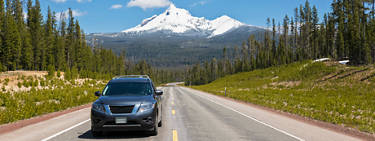
Summer road trips are worth planning but fuel costs can quickly add up – especially with today’s gas prices. Getting better gas mileage can help you spend less at the pump and more for your vacation.
The good news: many factors that affect fuel economy are within your control! Proper tire maintenance, good driving habits, smart route planning, and routine vehicle care can help improve efficiency and reduce fuel consumption.
Quick Answer:
The best ways to get the most gas mileage possible for your summer road trip include:
- Keep tires properly inflated (use vehicle manufacturer’s recommendation).
- Avoid excessive highway speeds.
- Accelerate and brake smoothly.
- Remove unnecessary cargo and roof-mounted accessories.
- Use cruise control on flat highways.
- Stay current on vehicle maintenance.
- Minimize unnecessary idling.
- Plan routes to avoid congestion and delays.
According to the U.S. Department of Energy and EPA, factors such as tire pressure, driving habits, vehicle maintenance, and speed can all affect fuel economy.
CHECK TIRE PRESSURE BEFORE YOUR TRIP
Although it is a simple thing to check, tire air pressure is one of the most commonly overlooked maintenance items.
According to FuelEconomy.gov, properly inflated tires can improve gas mileage by 0.6% with improvements of up to 3% in some cases. The Department of Energy also notes that underinflated tires can lower fuel economy by about 0.2% for every 1 psi drop in average tire pressure.
Summer’s high temperatures can cause tire pressure to fluctuate, making pre-trip inspections especially important. Always check tire pressure when the tires are cold. Inflate then to the vehicle manufacturer’s recommended psi, which is typically found on your driver door’s placard or in the owner’s manual.
Do not inflate your tires to the max air pressure listed on the tires!
Tire Pressure Checklist
- Check tire pressure before a long trip (here’s how)
You can also get a FREE air check from us!
AMERICA'S TIRE FREE AIR CHECK
- Follow the vehicle manufacturer’s recommended psi (NOT the max psi listed on your tire!)
- Inspect tires for irregular wear or damage
- Check tread depth (here’s how)
- Check your spare tire (if your vehicle has one)
CONSIDER LOW ROLLING RESISTANCE TIRES & PRE-TRIP TIRE INSPECTION
Some tires, such as touring and highway-terrain tires, support fuel efficiency better than others due to their design. These tires have low rolling resistance.
BEST FUEL EFFICIENT TIRESEnergy is required to turn your tire and move your vehicle forward. Also, as tires roll, they flex and generate heat. These factors create rolling resistance, which reduces your tire’s ability to roll easily.
Low rolling resistance (LRR) tires are designed to reduce this energy loss and improve efficiency. They prevent your vehicle from working as hard to keep it moving.
Actual fuel-economy improvements will vary by vehicle and driving conditions, but drivers can maximize efficiency using LRR tires and other tire models designed for fuel-conscious driving.
Why schedule a pre-trip inspection?
A tire inspection performed by a tire expert can help identify issues that may affect fuel economy, tire life, or safety – especially before a long trip.
A thorough inspection should include:
- Tire pressure check
- Tread depth measurement
- Treadwear inspection
- Tire health and damage assessment
Uneven wear patterns may indicate alignment or suspension issues that can increase rolling resistance and shorten tire life.
SIGNS YOUR TIRES MAY BE AFFECTING FUEL ECONOMY
Your tires can directly affect your fuel economy. Watch for:
- Frequently low tire pressure
- Uneven treadwear
- Vehicle pulling to one side
- Excessive vibration
- Lower than normal MPG
Addressing issues early, especially before a road trip, will help improve efficiency and reduce the likelihood of unexpected tire problems while travelling.
SPEED AND FUEL ECONOMY
Fuel economy generally decreases as speed increases due to aerodynamic drag that rises significantly at highway speeds.
According to the U.S. Environmental Protection Agency (EPA), higher speeds increase aerodynamic resistance which requires your engine to burn more fuel to maintain momentum.
Although fuel economy varies by vehicle, efficiency often begins noticeably declining as speed rises above 60mph.
| Speed | Fuel Economy Impact |
|---|---|
| 50-60mph* | Peak fuel economy |
| 65mph | Moderate reduction |
| 75+ mph | Significant reduction |
*Each vehicle has a different optimal fuel economy speed
Use Cruise Control Strategically
Cruise control can improve fuel efficiency by helping maintain consistent speeds. It works best on relatively flat highways where speed fluctuations are less common.
However, in mountainous or hilly terrain, manually adjusting speed may sometimes be more efficient because cruise control can increase throttle input in order to maintain set speeds on steep grades.
In traffic or heavily congested conditions, cruise control may not be appropriate. Some vehicles offer adaptive cruise control which helps maintain a smooth, consistent buffer distance. However, take into consideration that if you are cut off by an aggressive driver, your vehicle may brake suddenly and then aggressively accelerate to maintain your set speed.
For most interstate driving, cruise control is a useful fuel-saving tool.
AVOID AGGRESSIVE DRIVING
Not only is aggressive driving unsafe, it also takes a toll on your gas tank.
Rapid acceleration, speeding, and hard braking can significantly reduce fuel economy.
| Driving Condition | Fuel Economy Reduction |
|---|---|
| Highway | 15-30% |
| Stop and go/City driving | 10-40% |
Fuel-efficient driving habits include:
- Gradual acceleration
- Maintaining consistent speeds
- Anticipating traffic changes
- Leaving adequate following distances
- Avoid unnecessary lane changes
These habits can also reduce wear on your tires and brakes!
REDUCE EXCESS WEIGHT AND AERODYNAMIC DRAG
Extra weight and exterior accessories, such as roof racks, can increase fuel consumption.
Every pound your vehicle carries requires energy to move. Also, roof-mounted accessories such as storage racks or carriers create aerodynamic drag that reduces efficiency at highway speeds.
Before your trip, consider removing:
- Empty roof racks
- Unused cargo carriers
- Heavy tools (not needed for travel)
- Sports equipment (not needed for travel)
This is especially beneficial for SUVs, trucks, and vehicles towing trailers.
KEEP UP WITH BASIC VEHICLE & TIRE MAINTENANCE
Routine maintenance helps your vehicle operate at peak efficiency and safety.
Pre-Road Trip Maintenance Checklist
- Check tire pressure
Get a FREE air pressure check at America's Tire! - Inspect tread depth
Get a FREE tire inspection from experts at America's Tire! - Address alignment concerns
Check if your America's Tire offers alignment services! - Use manufacturer recommended motor oil
- Complete any overdue vehicle maintenance
- Investigate check engine lights
The Department of Energy (DOE) advises using the motor oil grade recommended by your vehicle manufacturer. Using a different motor oil can reduce gas mileage by 1-2%.
USE AIR CONDITIONING EFFICIENTLY DURING SUMMER
Air conditioning uses fuel, but driving with your windows down can also reduce efficiency at highway speeds. Both options affect fuel economy.
At higher speeds, open windows increase aerodynamic drag which can offset any fuel savings from turning off your A/C.
To improve efficiency:
- Park in shaded areas when possible
- Pre-cool your vehicle before departure
- Use cabin air recirculation once cool
- Avoid prolonged idling with the A/C running
PLAN SMARTER FUEL STOPS
Avoiding traffic and reducing unnecessary idling can help conserve fuel.
Before heading out:
- Check traffic conditions and plan route accordingly
- Avoid peak congestion times
- Combine stops when possible
- Use navigation apps to identify most efficient routes
- Plan fuel stops ahead of time
The EPA states that excessive idling wastes fuel, reduces overall efficiency, and adds unnecessary wear to your engine.
ARE PREMIUM FUELS WORTH IT FOR ROAD TRIPS?
Premium fuels are only worth it for road trips if your vehicle manufacturer recommends or requires it.
For most vehicles designed to run on regular gasoline, premium fuel does not generally provide enough fuel-economy benefits to justify the higher cost.
Always follow the fuel recommendations listed in your owner’s manual.
SUMMER ROAD TRIP FUEL-SAVINGS CHECKLIST
Before you hit the road, do the following to save fuel:
- Check your tire pressure
- Inspect your tire’s tread
- Remove unnecessary cargo and racks
- Verify maintenance is up to date
- Plan fuel stops and routes
- Avoid aggressive driving
- Use cruise control when appropriate
- Monitor fuel economy throughout the trip
FAQ
Using low rolling resistance tires, maintaining proper tire air pressure, driving at reasonable highway speeds, reducing excessive weight, and routine maintenance are among the most effective ways to improve fuel economy.
Generally, yes. Cruise control helps maintain a consistent speed and can improve fuel economy on flat highways. In some situations, such as mountainous and hilly conditions, it is better to manually adjust speed.
Fuel economy varies by vehicle but fuel efficiency generally decreases as speed increases due to aerodynamic drag.
Yes, air conditioning increases engine load which decreases fuel economy. However, driving with open windows at highway speeds also reduces efficiency due to drag.
Yes. According to the Department of Energy, proper tire inflation can improve gas mileage by an average of 0.6% with improvements up to 3% in some cases.
They can. Roof racks and cargo carriers increase aerodynamic drag, especially at highway speeds, which reduce fuel economy.
Not unless your vehicle specifically requires premium fuel. Most vehicles designed for regular gasoline won’t see meaningful fuel-economy benefits from premium fuel.
Increased air conditioning use, heavier traffic, and road-trip cargo loads can all contribute to lower fuel economy during the summer.
Ready to roll?
Getting better gas mileage on a summer road trip doesn’t require major changes. By simply maintaining your tires and vehicle, using low rolling resistance tires, reducing unnecessary weight, and adopting safe driving habits, you can maximize every gallon of fuel.
Make sure to get a pre-trip tire inspection to check the health of your tires and ensure they’re ready for the miles ahead. Turn to us to make sure you’re good to go. We’ll get you taken care of.
If you have any questions or are unsure what tires work best for you, drop in or give us a ring. We’ll get you taken care of. Buy and book online and save time in-store!
For more information on this and other tire and wheel services, check out ourYouTube Channel or reach out to us on X, Instagram and Facebook.